Saturday, 27 August 2011

Alexandria

It's been a couple of weeks since the last post, basically down to a lack of internet access wherever I've been, but not so anymore.


Arriving in Alexandria was literally a breath of fresh air. After the close, stifling heat of Cairo the cool sea breeze was instantly satisfying. We checked into the hotel we had found the day before on the internet and enjoyed the view along the sea front and the city from a balcony twice the size of the room. Alexandria is around 13 miles long but never more than 2 miles deep. It stretches along two wide harbours and further up the coastline on either end, the promenade lined with cafes and restaurants. We were placed fairly firmly in the centre, on the front.


The next few days were a mixture of pleasure and chores. Finding a flat was the first priority and I got to this fairly quickly. I won't go into viewings that didn't work out, or into the exact details. To get the one I decided upon, I spoke to a man who sent me to a doorman who introduced me to an old man who made a phone call for me to another man who rents out flats. I got a blank look from the first person I tried to describe an estate agent to; as with much else here, who you know is the most important thing.

Interspersed with this timewere slightly more entertaining activities. An awful lot of the time spent here has been given over to simple pleasures; strolling, eating, sitting in cafes and generally soaking up the feel of the place. The seafood here has been wonderful and, as money goes alot further here, a good meal at one of the best restaurants in town is unlikely to cost much more than £12, even though it is comparitively very expensive. This is something we exploited here more than anywhere else.

Our pace here has mostly been restricted by Ramadan. Any tourist site or official building or even things like banks will only open 9-1:30. However, the people here tend to sleep til mid-day to avoid the sun and the hunger that comes with it. They then wake up, once everything has closed, don't do much for a few hours then, once the sun goes down around 7, the city comes alive

We did however manage to visit many of the historical sites in the city. Pompey's pillar (named incorrectly, the pillar was actually raised to mark a visit of the Emporor Diocletian to the city) is the sole part of ancient Alexandria left standing today. A pillar of gigantic proportions which towers over the very ruined ruins of a temple and a library.


Also, a set of catacombs which were discovered when a donkey accidentally fell down a large pit, uncovering a crypt containing bizarre carvings and paintings. These depict Egyptian gods but with several Roman or Hellenic features to them, or statues in Egyptian garb with Roman faces. This style is prevalent through much of Alexandria's ancient art: a mixture of the old gods as befits an Egyptian town founded by Alexander the Great.


The museum in Alexandria was also very good. Although nowhere near as large as the museum in Cairo, the slection of artefacts and the way in which they were laid out in a logical way, progressing through time with ample descriptions actually made it just as interesting than the other who's sprawling range of artefacts with little information or order make it more of a treasure trove than a museum.

The fort of Qaitbey which sits on a spit of land and overlooks the entrance to one of the harbours is on the site of the ancient Pharos, the lighthouse which towered some 400 ft over the ports for hundreds of years. Gradually, due to succesive earthquakes and fires, the lighthouse fell into disrepair until 1323 when one final earthquake finished it off. From the rubble, the Sultan of Egypt at the time, Qaitbey, built his fort here.


We explored the battlements and walls, all the time with the sea crashing around the base, and very much enjoyed the ambience.

We also spent a day in a place still within the confines of Alexandria but quite a long way up the coast called Montaza. Here there is a presidential palace (now disused I suppose), a beach, a coupe of luxury hotels and a wide area of grass, palms, trees and bushes. We spent the day wandering through the gardens and swimming in the sea and finished off with a meal in the seafood restaurant in the resort.

After about a week once a flat had been found I was told it would not be ready to move into for a few more days. So, rather than simply staying and waiting for it to become available we decided to pack up again and leave Alexandria. We found the bus station and bought tickets for the 8 hour bus ride along the coast then into the desert to an oasis near the border with Libya called Siwa.

Thursday, 11 August 2011

Cairo

We arrived in Cairo after a long day of travelling. A bus from Jerusalem at 9 took us south through the Negev desert all the way to Eilat where we arrived at about 12:30. We crossed the border into Egypt on foot. Surprisingly, taking into account how arduous it had been to get into Israel, the crossing took less than half an hour. It seems the Israelis don’t particularly mind people leaving their country. From Taba, the town on the other side of the border, we found a bus to take us to Cairo. Before us stretched Sinai. The road was long and straight with nothing but rocks, sand and the odd military base on either side of it. Finally, having been travelling for a good 14 hours we arrived in Cairo and checked into a hotel. Not the one we booked, because it turned out it was full, but into the nicer one owned by the same people which they moved us to. This was maybe the best thing that happened to us throughout our time there as this place had air-conditioning, something which was far more appreciated than in any other place we had been. 


Cairo was hot. Very hot. And very humid. So much so that even sitting was an effort. Our days in Cairo were much less full than anywhere else we had been. Since it is Ramadan, all tourist sites were closing early, around 2 or 3. Even before then we started to flag though and by 3 were generally back in the hotel room napping.

On the second day we went out and walked through the newly cleared Tahrir square to the Egyptian museum, the burnt out remains of Mubarak’s party headquarters looming behind it. The museum was a treasure trove. If you can think of any type of artefact or relic from Pharonic times, they had a dozen of them. Some of the descriptions of the artefacts were a little lacking but the museum made up for that in sheer volume, both of famous and unknown artefacts. The mummy rooms, Tutankhamen’s burial mask and sarcophagus were a delight. Other parts held less renowned treasures, such as a stele with the sole mention of the Israelites on any Egyptian artefact (amusingly stating that they were destroyed, no more, and their seed had been wiped out). No photos however; as it seems with all museums or sites in Egypt that are contained and thus regulated, cameras had to be left at the door.

On our way out we were part greeted, part accosted by someone in the street. I’m not entirely sure how (like I say, it was very hot and this was around 3 o’clock) but after around half an hour we walked away having booked ourselves dinner on a boat on the Nile for that evening. Needless to say it was wonderful. The food was delicious and the accompanying band fantastic. 

There were also dancers.

The following morning we hired a taxi for the day and set off to see the pyramids. There are 3 sets of pyramids around Cairo: Dah shour, Saqqara and Giza (this being the order in which we saw them). Dah shour was only opened to the public some ten years ago and on the site is the world’s first true pyramid. Next to it, it’s malformed brother, known as the bent pyramid. This was the first non-step pyramid. About half way up they realised that the 56 degree angle they were taking was untenable and so levelled off to 43, thus the name. The inner chambers of the less bent of the two are also open to the public. Large ceilings and huge pieces of cut stone line the inside.


Saqqara was equally impressive.  The pyramids at this site are step pyramids. However, we didn’t spend so much time at this site, due to its smaller size and wanting more time at Giza.

When we arrived at Giza we rented a guide and horses for the time we would be there. In part this was due to the sweltering heat which was truly upon us by the time we arrived and also because of the size of the site. 


With the 3 great pyramids, several smaller ones, a small temple, ruins, the temple of the sphinx and the sphinx itself laid out across sand dunes and rocky outcrops, having something else do our walking for us seemed like a good idea. It was. As a way to tour the site this was wonderful and, although a tad pricey in comparison to any other expenditure, still a good price. We made sure to take our time throughout and this was one of the few places we have been to thus far in Egypt which allowed cameras inside. Afterwards, we returned to the hotel and slept.


The next day we went out and explored a different area of Cairo, the old town. Although we missed getting to look round the synagogue by just a few minutes (Ramadan opening hours again) we managed to see most of the sights in the area. The old town is home to many of Cairo’s Coptic Christians and thus their churches and a museum dedicated to Coptic artwork and culture. All very interesting.

This was essentially the end of our time being tourists in Cairo. After three days of walking around trying to be busy the heat and humidity finally got to us. We spent the next couple of days either in the hotel room or going out for short walks and ventures in the morning and evening, but even at those times it was unpleasant to be outside. After a couple of days the next move was clear: to Alexandria! 


Further Notes on Israel


Having had some time I thought I would write some further comments on my time in Israel, specifically on two matters. The first is political; the second is Yad Vashem, the holocaust museum.
As you may or may not have heard, during the time which I was in Israel, and still at present, there were large groups of protestors living in campsites in the centres of every major city and many of the smaller ones. There have also been some of the biggest marches and demonstrations in the history of the country. The majority of those protesting are under 30, students or workers in a variety of sectors and their complaint is that they simply do not receive enough money to get to the end of the month.
The protests started, funnily enough, over cottage cheese. To Israelis this is a staple food; on the table every breakfast and to many the taste of home.  When the price of a small tub rose to over 7 shekels (around £1.40) a Facebook campaign, which rapidly gained popularity, instigated a boycott of the product. Soon after the price was dropped.
The underlying problems however did not go away. The cost of housing is incredibly prohibitive.  Even having rented in central London I was shocked at how much the people we met were spending on rent. Food was also incredibly expensive, and the cost of going out was ridiculous (22-28 shekels for a half litre of beer, between £4.40 and £5.60, was standard). Bills I was also assured were equally high.
The demonstrations have come as a shock to both politicians and people alike and are currently quite unfocussed, with those involved having an idea of what they want (i.e.: cheaper rent, better pay etc.) but the demonstrators lack any clear demands. And for the situation to change there would have to be a massive shift in the status quo. A handful of companies control each market, a couple for food, a couple for gas etc. On top of that, there are also a select number of influential families within the country, many of whom go back to some of the first Zionist pioneers to colonise the country, who have a stake in many of these sectors. It is not in their interest for prices to drop and, as in any other country, it is they who have the ear of the government.
In any case, those who we spoke to were passionate about trying to effect some kind of change and, whatever the outcome, there has been a definite shift in a country where the government does not expect hundreds of thousands of its citizens to be taking to the streets.

And on to Yad Vashem. Meaning “A memorial and a name”, a quotation from the book of Elijah, the Yad Vashem institute was set up in Israel after the war to commemorate the dead, study the Holocaust and research the lives and communities of the Jewry of Europe who had been slaughtered by the Nazis. It has collected videos from a huge number of the survivors of the Holocaust telling their experiences and clips from these make up a large part of the museum. This I found to be its main asset, above any other museum or memorial to this event I have ever seen; the living testimony of those who experienced it.
There were however many uncomfortable moments whilst going through the museum, not just because of its subject matter, but because of the political undertones which could be felt through many of the exhibits. The museum begins with a room about anti-Semitism, historical and modern. This, without flinching, drew a direct line between Christianity, the blood libels of the Middle-Ages and Hitler. A board game produced by the Nazis was displayed next to an image of a painting of Jews killing children, painted in the middle ages. Immediately the founding idea of Zionism, that Jewish life outside of the land of Israel is impossible, was laid out to the visitors.
In a later exhibit the spectre of Zionism looms even stronger. The museum devotes almost as much space to the Jewish partisans and members of the resistance as it does to the concentration camps, despite the fact that the numbers of those involved was small and their influence minimal.  And so, further Zionist tenets of resistance and strength when put in a position of danger are thrust forward.
These points would be minimal were it not for the architecture and position of the building. The museum is a long triangular tunnel set into the mountain with exhibit rooms to either side. The visitor moves slowly forward, snaking from side to side, until the end, reaching the literal light at the end of the tunnel, which is a platform with a panorama of Jerusalem. Thus, Jerusalem and the land of Israel are inextricably linked in the mind of the visitor to the horrors of the Holocaust.
The museum is also positioned directly next to Har HaZikaron, the mountain of memory. Recently the two have been connected by a path built by Zionist youth groups. On this mountain are Israel’s military cemetery, the graves of past presidents and prime ministers, monuments to victims of terrorism and even the grave of Theodore Herzl, the founder of Zionism.  So, on leaving the museum one can follow this path up and celebrate the existence of the state of Israel.
For the most part Yad Vashem was a moving memorial to those who were murdered in Europe in the 1940s and the testimonies of those who survived provide a living witness to the events.
I just don’t think politics and museums should go together.

Tuesday, 2 August 2011

On to Jerusalem.

So another week or so has passed and the time comes to sit and write its events.
Althoughour original plan had been to leave Jordan as soon as my Dad did we were inevitably sidetracked. I overheard a conersation the hotel in which we had been staying in Amman between the hotel manager and a couple from New Zealand about going to the Dead Sea. They were trying to work out the best price and he was telling them that to go any lower they would have to find another two people...


So, the next morning we were in a taxi to the Amman beach of the dead sea.

We spent the day lounging around floating. The water is around 400 metres below sea level, the lowest elevation on earth, and salinity is at about 33%. Due to its density it's actually impossible to sink. Either upright or on your back you just bob along.

The next day we got up, left the hotel and headed to the border. This took quite some time, beyond which there isn't really much to say about the experience. Just that Israeli security and police are far more difficult to deal with than anyone else I have met in Israel.

When we finally did get through, we headed straight for Jerusalem and checked ourselves into a hostel next to the Damascus gate. This was Tuesday the 26th of July.

Between tuesday and thursday I was partially occupied with completing my application to the Hebrew University of Jerusalem. This involved filling out forms and going between the hostel and the university. The rest of the time we spent exploring the Old City and seeing a variety of religious sites from a variety of religions.


This surprisingly small area of Jerusalem, which is now far greater in size than that which is contained within the walls, is filled with winding streets, markets and clearly defined quarters:  Muslim; Jewish; Armenian; and Christian.
Over these two and a half days we managed to see many (if not all) of the sites within the Old City, from the Church of the Holy Sepulchre to the Temple Mount.

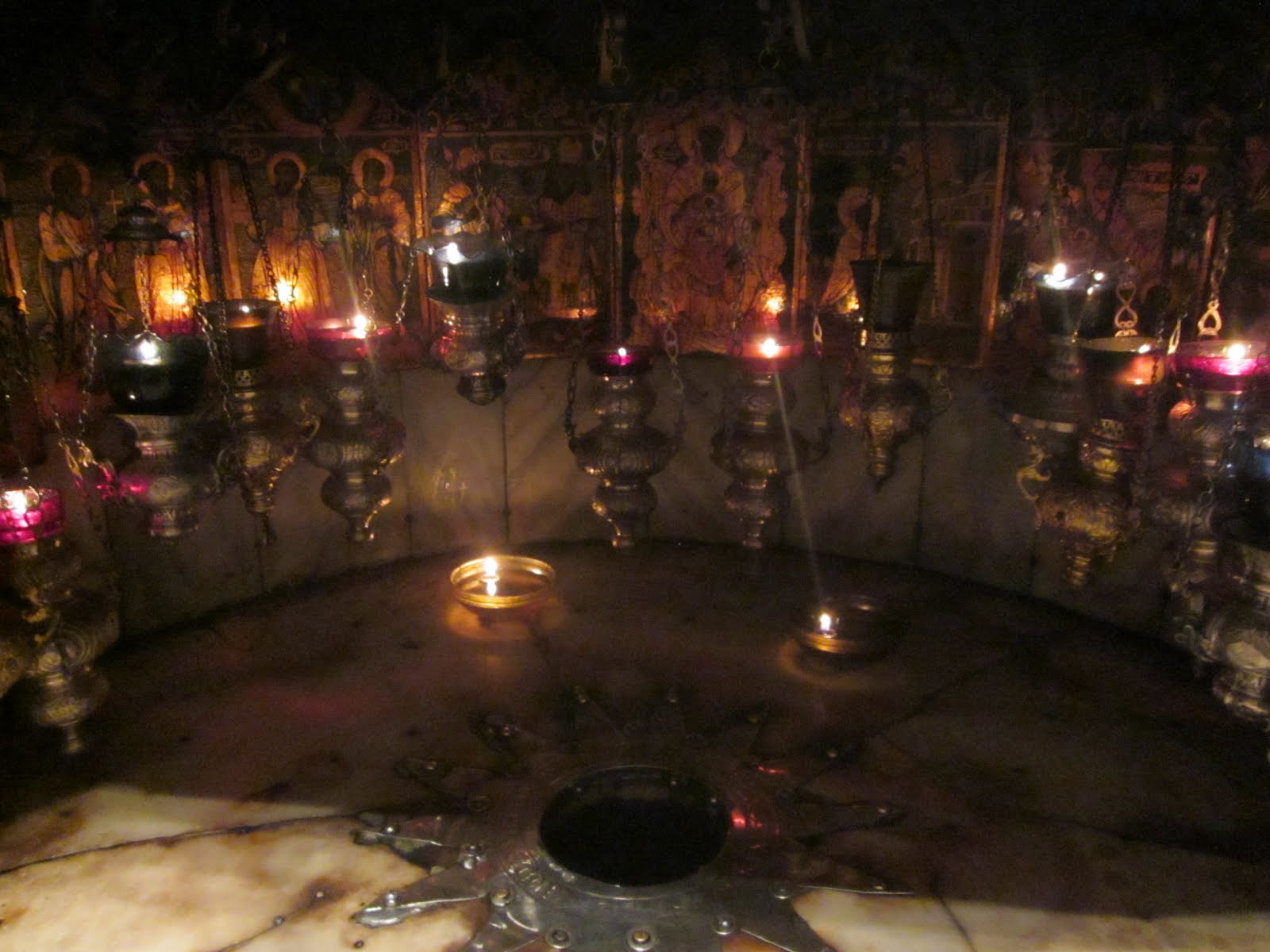
The next day (Friday) we went to Bethlehem and to the Church of the Nativity. This beautiful little town is no more than a 15 minute drive from Jerusalem, and yet feels much further away, in part due to the imposing Security wall (if you ask an Israeli) or Apartheid wall (if you ask a Palestinian). In spite of the economic suppression that the Palestinians suffer, Bethlehem was filled with cafes and restaurants, many of which will cater to the pilgrims who flock to the town.


Another attraction of Bethlehem, and an unexpected consequence of the Separation wall, is that graffiti artists from all over Palestine and the rest of the world have flocked to this 450 mile long blank canvas.


Later that day we checked out of our hostel and went to stay with some people we had found through http://www.couchsurfing.org/ , a website which allows you to find people in pretty much any city who are willing to open their doors to you and let you sleep on their sofa. It uses a system of references to allow you to see whether someone is trustworthy or not. So, if someone's profile has good references from people who have stayed with them previously from another country then they are going to be trustworthy. If not, don't stay with them. This has worked out brilliantly, giving us somewhere to stay and me people to know in Jerusalem, and I would reccommend the project to anyone.

Through couchsurfing we met Moran and Alon who put us up in their house on a Moshav (a type of Israeli communal town) just outside Jerusalem where we spent two nights. Seeing this other side of Israel and staying out in the countryside, with a fantastic view of Jerusalem, was a real pleasure. Then, on sunday, we came to stay with Eli and Rotem right in the centre of Jerusalem. They have showed us around, taking us to bars and pointing us in the way of lesser known but equally beautiful places. For example, today we went to a spring in the hills a bus ride and a walk outside of the town centre where we spent the day swimming in the spring and lying in the sun.

And tomorrow we leave. This last week in Jerusalem has been wonderful, with sights, nightlife and people to show us around. Other things of note from during the week are Yad Vashem and Mount Herzl, the Holocaust museum and mountain of memorials and military cemetaries, and Jachnon, a wrap with egg, tahini, salads and spicy sauce.

Until next time

Chris

Sunday, 24 July 2011

First week (and a bit)

So, although it's taken a little longer than the week I said, here is an account of the last ten days or so spent at the start of My Big Holiday.
My dad has been with myself and Emily up until an hour or so ago and it's been lovely having him here. This is what we did.

We arrived late last thursday (14/7) into Amman and stayed in a hotel. Basic but nice.
http://www.hostels.com/hostels/amman/mansour-hotel/22700

This however was just a stepping stone. We set off immediately early the next morning for the south and Wadi Rum. This took some time but after what felt like an age of travelling arrived there at around 12. A taxi driver directed us to Mohammed Sabah and Sunset Camp.
http://www.wadirumsunset.com/

Sitting down for tea, we looked at the possibilities for what we would do for the next couple of days in the desert. Somewhat predictably, we ended up doing this:

We hired a guide and three camels and set off into the desert. Exploring the vast arid and beautiful landscape was our mission for the next few days. The first we spent moving around Wadi Rum, setting off almost as soon as we arrived. Moving from place to place in the Wadi (the spring where T.E. Lawrence would shower, Nabatean carvings in a gorge) and eventually stopped at the Bedouin camp out in the desert. There we stopped, ate, were entertained by an Oud and eventually slept soundly in our tent (after having encountered a group of students from Amman). The second day we went out into Wadi Rus, going around 20km out towards the Saudi border. The landscape, though desolate, was incredibly beautiful and the colours and shapes of the rocks and sands shifted gradually as the camels lumbered along (a note on that, although intially uncomfortable, once a position had been found that allowed you to sit well they weren't all that bad)

These two days were incredible, the bedouin hospitable and a camel the only way to travel.

The next day was again spent travelling, north from here on in, to Petra. Arriving fairly late in the day (around 2 in the afternooon) we arrived in Wadi Musa, the town next to Petra. Deciding it was too late in the day to set off for Petra (a huge attraction, the visiting of which had been a lifetime ambition of my dad's) we settled back briefly for a cup of tea on the roof terrace and, when the sun had let off a little of the intense, dry heat, went further out to the area known as "Little Petra". This was a gorge a little way away from the main site but by no means less interesting. Situated there was a collection of caves, stairs cut up the side of the gorge and water cisterns carved directly into the rock. Fascinating by all means but by far an easier way to spend the afternoon.

The next day we set out early for Petra proper... We explored both the most spectacular and most famous sites within and spent much time clambering around the smaller caves. Most of the site which has been excavated (around 5%, a staggering figure when its vastness is taken into account) was once the funerary complex of the capital of the Nabateans, a group of people who, although never in possession of an empire, held sway over a sphere of influence which extended from Damascus to the south of the Arabian peninsula, and taxed the caravan routes which went through this area. They had a rich culture, with Hellenistic and Latin influences, and buried their dead in caves carved into the very rock of the gorges within which their capital lay. These influences are apparent in the style of their architecture, some of which still remains.
One of the joys of these days was the lack of other tourists on the site, due in part to the hit the tourist trade has taken on account of the current troubles in the region. We found ourselves able to wander and explore without having to jostle for a position.
The monastery at Petra
Already a highlight.

The next day we went north to Karak, site of the ancient Kingdom of Moab, mentioned in the books of Kings and Amos, and now famous for the castle built by Frankish crusaders in the 12th century. Although now in  fairly bad state, its former glory was obvious. Towering over the modern town, this was a marvel of architecture and engineering.
It is worth noting here that many of the places we have visited over the last week in Jordan, with the notable exception of Madaba (more to come) were not in a particularly good way. Poorly kept with little to no work done in terms of conservation of repair, there is a clear need for the Jordanian government or others to do more to ensure the survival of these treasures. This was most obvious in the museums at these sites. Despite being vast, little is on show in the way of artefacts and remains, seemingly down to a simple lack of work. A great shame indeed.

The underground marketplace in Karak castle

The next day we set off for Madaba. This is the heart of Jordan's Christian community, with over a third of the population from one denomination or another (mostly either Greek Orthodox or Catholic) and the site of some of the best preserved Roman mosaics I have ever seen either in person or in picture. St. George's church (Orthodox) is home to the oldest known map of the Middle East. Detailed in mosaic on the floor, although now partially incomplete, one can clearly see Jerusalem, the Jordan, the Dead Sea and many other Biblical landmarks laid out precisely on the floor of the church. This, however, was not the highlight. The town boasts an array of modern churches, ruins of Byzantine churches complete with mosaics and Roman ruins.
We found the town to have a fantastic atmosphere with beautiful attractions.
Thalassa, personification of the sea, in the Church of the Apostles, Madaba


A highlight was the Catholic cathedral dedicated to John the Baptist. The curator took us around and up the bell tower and told us of the visit of the late Pope John Paul II to the town, during which he gave a sermon and, along with the King, reconsecrated the church after its renovation. Alongside it was a small gallery with a collection of photographs taken in the town around the turn of the last century, some of which can be seen here http://www.mansaf.org/catholic/madaba2.htm.

Yesterday we moved on again, this time to Jerash and to another set of Roman ruins. The town, then known as Gerasa, was part of the Roman Decapolis and derived its wealth from the rich soil of the surrounding area. A wide area, again poorly excavated (we were finding pieces of Roman pottery simply lying in the dirt as we walked around) containing two theatres, several churches with beautiful mosaic and a colonnaded street with original paving occupied us for several hours longer than the guidebook would have had us believe. Incredible examples of Roman civic buildings throughout.
We stayed this last night in a nice hotel located outside of the town and enjoyed the views, cool breeze and a meal together.


This morning and afternoon was spent in Amman, where we had also spent some time on the Friday (22nd).

All in all this last week has been wonderful. I apologise for a lack of pictures but the internet bandwidth isn't sufficient to upload more without it taking all night.
Until next week.
x